In our recent webinar, Prof. Barnaby Lenon CBE and his colleague and co-author at the University of Buckingham, Tracey Smith, explored the qualities that define effective teaching — beyond qualifications, frameworks, or checklists.
Prof. Lenon has been instrumental in the leadership of some of the best secondary schools in the UK, including Harrow, Highgate and the London Academy of Excellence, while Tracey Smith has spent the majority of her career either leading or advising primary schools.
Now, Prof. Lenon is Dean of Education at the University of Buckingham, where Tracey Smith has also been Head of Primary Teacher training. Training students to become the best teachers in the country is their new modus operandi.
During the webinar, the pair gave their views on how the qualities and skills needed at primary and secondary level differ. Do you agree? Read on to find out…
1. Defining Excellence: Why the Setting Matters
Excellence in teaching is not a static trait but highly contextualised. As Professor Barnaby Lenon observes, good teachers must be flexible, shifting their strategies based on the environment in which they teach. To ground this in global research, one must look to the Education Endowment Foundation (EEF) and John Hattie’s "Visible Learning," which demonstrate that while certain high-impact strategies are universal, their application must be calibrated to the specific classroom ecosystem.
For an educator to flourish, they must align their personal strengths with the four primary variables that define the teaching role:
• Age of Pupils: The cognitive and developmental needs of a five-year-old require a vastly different pedagogical approach than the sophisticated demands of an eighteen-year-old.
• School Selection and Ability Range: Success in an academically selective school requires different management and stretching techniques than those needed in a school with a high proportion of special educational needs (SEN) or social disadvantage.
• Subject Matter: The instructional architecture of a physics laboratory—focused on concrete laws and empirical evidence—is distinct from the expressive, open-ended pedagogy of an art studio.
• Individual Care: Excellence is often measured not just by exam results, but by a teacher’s capacity to provide pastoral support and build a reputation for genuine care.
Evidence of this contextual success is seen in England’s recent PISA ranking improvement, moving from 26th to 11th globally in Mathematics. This shift demonstrates that when high-impact variables are managed through specific structural reforms, student outcomes accelerate. Understanding these variables is the first step in identifying where an educator's personal strengths will flourish. And the primary and secondary settings possess distinct identities.
2. The Primary Setting: Relationships and Pastoral Foundations
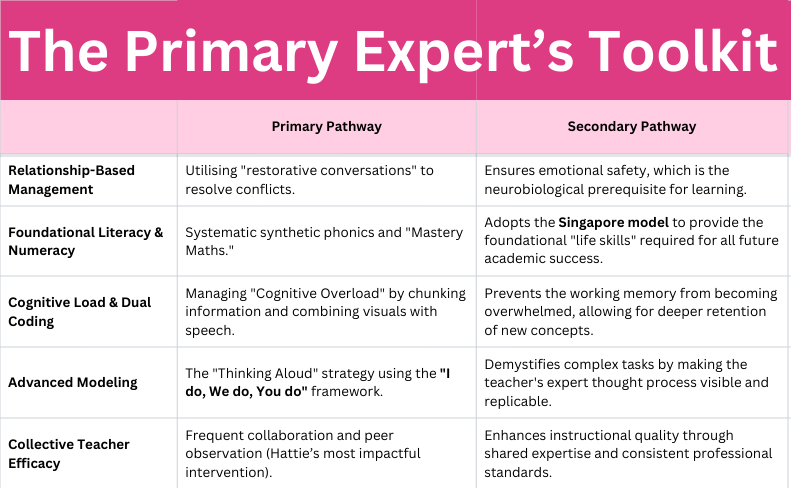
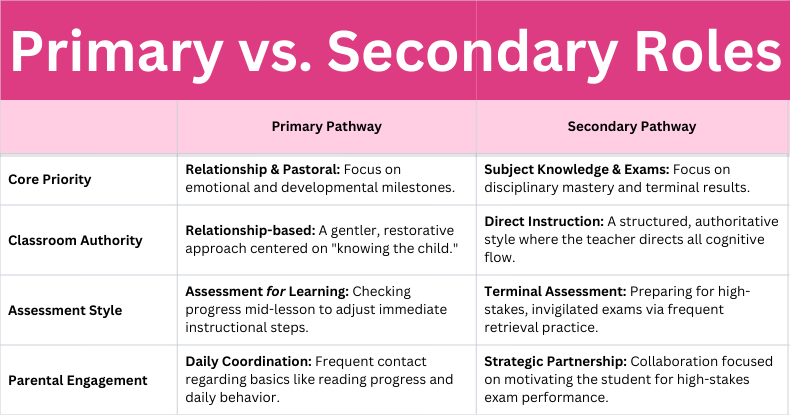
Primary education is defined by a "Pastoral Care" model. Expert Tracey Smith emphasises that the primary practitioner is the central figure for every developmental milestone and minor upset a child experiences. Here, the relationship with the pupil—and by extension, the parent—is the primary engine of learning. A child who feels secure and likes their teacher is cognitively primed for engagement.
3. The Secondary Setting: Subject Specialism and Knowledge Mastery
In secondary education, the educator evolves from a generalist into a Subject Specialist. Professor Lenon advocates for a "Knowledge-Rich" curriculum, rooted in the principle that students cannot exercise high-level skills—such as critical thinking or analysis—without a deep well of factual knowledge. One cannot think critically about Biology without first knowing Biology.
The "Nick Gibb" reforms in England identified four pillars of instruction that drive these high-performance results:
1. Knowledge-Rich Curriculum: Teaching a high volume of facts and high-level texts. This ensures pupils possess the "mental furniture" necessary to engage in sophisticated subject-specific tasks.
2. Teacher-Led Instruction: The teacher directs all classroom activity from the front. This ensures the expert remains the primary source of information and prevents the inefficiencies of "discovery" models.
3. Checking for Understanding: Constant questioning and "mini-assessments" throughout the lesson. This identifies gaps in real-time, preventing misconceptions from taking root.
4. Retrieval Practice: Driving information into long-term memory through regular testing. To be effective, this must occur every two weeks as a minimum, and in subjects like Maths or Languages, it should occur every single lesson.
Despite these differences in focus, there are universal "gold standards" that apply to every classroom regardless of the age of the pupils.
4. The Great Comparison: Primary vs. Secondary Roles
5. Universal Pillars of Effective Teaching
Great teachers share a common DNA. Regardless of the setting, the following habits are the non-negotiables of professional mastery:
Universal Success Checklist
• High Expectations (The Pygmalion Effect): Educators must "teach to the top" and provide scaffolds for the struggling, rather than lowering the ceiling. Research shows that pupils perform to the level of expectation communicated by the teacher.
• Reflective Practice: Excellence is the result of constant self-evaluation. Effective teachers observe expert colleagues weekly to "steal" techniques and rigorously evaluate their own lesson impact.
• Behavior Management: Order is the prerequisite for subject delivery. The teacher must establish themselves as the "adult in the room" before instruction can begin.
• Deep Subject Knowledge: Even primary teachers must know "beyond" the curriculum. This allows the educator to stretch high-achieving pupils and answer "why" questions with intellectual authority.
6. Pedagogical Pitfalls: Methods to Avoid
To ensure rapid student progress, the research cited by Lenon and Smith suggests avoiding "progressive" methods that often stall learning:
• Discovery Learning: Allowing pupils to find out information for themselves is significantly less effective than direct instruction.
• Excessive Group Projects: These often lead to "slower" progress and can be easily corrupted by unequal participation or lack of expert guidance.
• Over-Reliance on Screen-based Learning: It is fundamentally harder to learn from a screen. Effective practitioners prioritise written notes and physical texts to aid retention.
7. Navigating Your Choice: Reflection and Career Growth
Aspiring educators must distinguish between the "Teacher" and the "System." In highly structured environments like the Michaela Community School, the system is the star. By implementing strict rules on things like silent corridors, rejecting standard textbooks in favor of high-level, teacher-authored texts, and teaching to a higher level from a younger age, the school ensures that even an average teacher can achieve world-class results.
However, for the individual, the ultimate guide is your own passion for either the subject or the age group:
1. Does my passion lie in the evolution of a single subject (Geography, Physics, History) or in the developmental milestones of a child’s early years?
2. Do I prefer a pastoral, restorative approach to behavior, or do I thrive as the "adult in the room" in a structured, direct-instruction environment?
3. Am I driven by the "value-added" progress of long-term, high-stakes exams or the foundational mastery of life-essential skills like reading?
Teaching becomes truly magical when the educator is matched with the right setting. Whether you choose the foundational warmth of the primary classroom or the intellectual rigor of the secondary lecture, understanding these evidence-based methodologies is your first step toward mastery.
Speaker Bios:
Prof. Barnaby Lenon CBE
Prof. Lenon has taught in and lead some of the best schools in the UK, including Eton, Highgate and Harrow. He later helped establish the London Academy of Excellence in East London, one of the most successful state sixth form academies in the UK. Now, Prof. Lenon is Dean of Education at the University of Buckingham, where he spends his time perfecting the art of training teachers.
Tracey Smith
Tracey Smith taught at Stadhampton and St Francis primary schools in Oxfordshire and then was Headteacher at Bladon, Tower Hill and New Marston primary Schools in Oxfordshire, before becoming Head of Primary Teacher Training at the University of Buckingham, Tracey returned to Headship as Executive Headteacher of two Faringdon primary Schools before continuing working with teacher training and supervision at the University of Buckingham.